Historically, very few retail funds have used derivatives, leaving these more exotic financial tools to the ‘Hedgees’ i.e., hedge fund managers. They use futures and options for gaining exposure across a wide variety of assets to hedge their funds from market volatility, as a means to get exposure to an asset in a cheaper format or to gear/leverage their fund. However, most jurisdictions believe that if you have lots of money (i.e., an HNW investor) you can invest in the alternative funds such as hedge funds. Not only can an HNW investors afford the high minimum initial investment for these...
Historically, very few retail funds have used derivatives, leaving these more exotic financial tools to the ‘Hedgees’ i.e., hedge fund managers. They use futures and options for gaining exposure across a wide variety of assets to hedge their funds from market volatility, as a means to get exposure to an asset in a cheaper format or to gear/leverage their fund. However, most jurisdictions believe that if you have lots of money (i.e., an HNW investor) you can invest in the alternative funds such as hedge funds. Not only can an HNW investors afford the high minimum initial investment for these funds, but HNW investors are presumed to be more sophisticated, or have better access for obtaining appropriate professional advice before investing.
Meanwhile, the DeFi sector would appear to be disbanding the arbitrary restrictions that regulators have historically imposed, enabling investors to allocate relatively small sums of capital to investment strategies - which may be the same, or very similar, to a hedge fund manager. An example of this is ByteTree which has built a sophisticated range of trading algorithms to manage its’ Bitcoin and general fund (focused on trading Bitcoin) and has a minimum investment of $100,000. Alternatively, it is possible via TokenSets to invest a much smaller sum and gain exposure to ByteTree’s trading. To invest, all that is required is a phone number, an Ethereum wallet and an email - no KYC and no AML so extremely easy, but also potentially open to abuse.
TokenSet’s ByteTree performance v Bitcoin
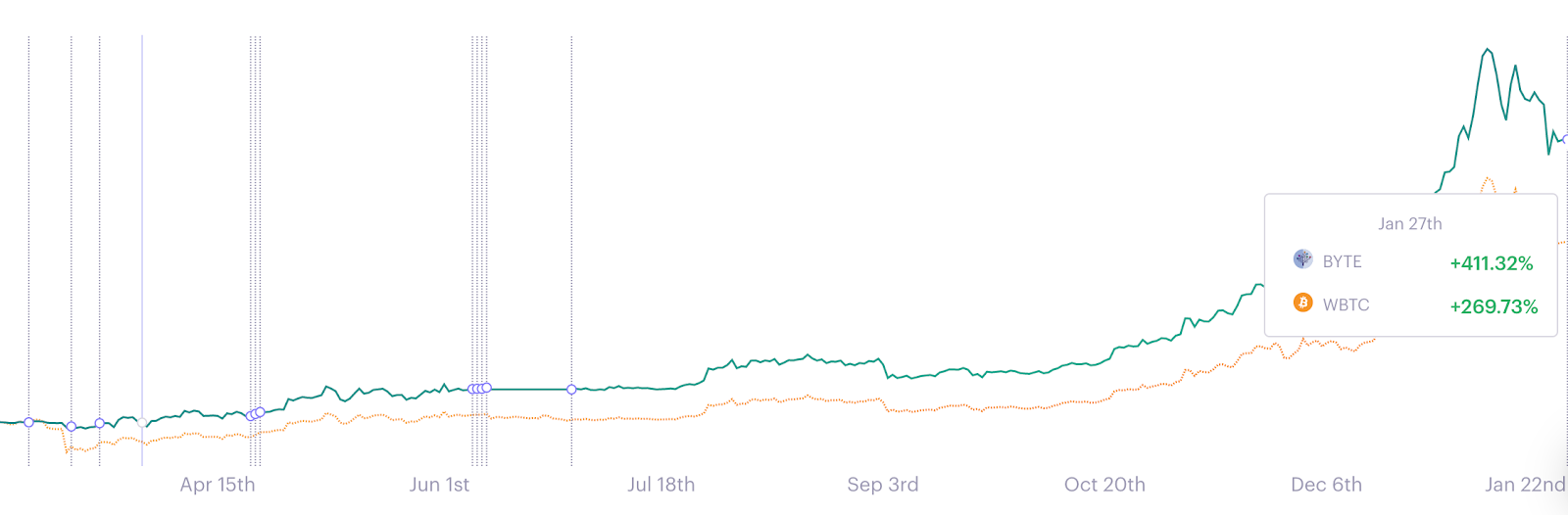
Source: TokensSet (the vertical lines on the chart above indicate when BTYE token was rebalanced)
Whilst the TokenSet’s fund is not exactly the same as the ByteTree’s fund, it is a way to access the latter’s fund managers. Given the performance against Bitcoin, it is easy to see why Byetree’s fund management skills are gaining so much interest. However, when investing via TokenSets there is no requirement to complete KYC or AML procedures, so ‘super easy’, but also potentially open to abuse.
But caution is required, as a $500 investment would incur a ‘listing fee’ of $107, i.e., 20%. When asked about the listing fee, TokenSets stated that it is the cost of accessing the Ethereum network. The listing fee so is high due to the current demand to use the Ethereum Blockchain. Such a high fixed fee will no doubt act as a deterrent for smaller investors - so will this potentially give comfort to regulators?