Furthermore, Blockchain technology is being used by governments as a means to do away with paper records. In Australia, the government is looking to remove the requirement for cheques, paper signatures and the need to place notices in newspapers, as outlined in its recent Treasury consultation paper, thus opening a way to use Blockchain technology instead. After all, the practice of posting a notification in the London Gazette, which dates back to 1665, as there are various Laws, Acts, Rules, Orders and Government decisions that require to be published. At least the Gazette is now published on-line; so, if you...
Furthermore, Blockchain technology is being used by governments as a means to do away with paper records. In Australia, the government is looking to remove the requirement for cheques, paper signatures and the need to place notices in newspapers, as outlined in its recent Treasury consultation paper, thus opening a way to use Blockchain technology instead. After all, the practice of posting a notification in the London Gazette, which dates back to 1665, as there are various Laws, Acts, Rules, Orders and Government decisions that require to be published. At least the Gazette is now published on-line; so, if you have the urge to check to see if you are in the New Year’s Honours List, you know where to go! Meanwhile in Germany, there will no longer be the requirement to issue securities in a paper-based format with the German’s authorities now allowing certain debt instruments to be issued digitally on a Blockchain-based register. This is also due to be the case in Switzerland as the Swiss have legislation coming into force on 1st Feb 2021 enabling shares, bonds and other securities to be issued electronically, thus removing the need for paper-based documentation.
Post this last year’s global pandemic, a digital solution to your identity (combined with your COVID-19 vaccination details) may well be the only way for permitted travel to certain countries in 2021, such as Australia. The International Air Transport Association (IATA), the lobby group of the world’s airlines, stated it would launch a digital health travel pass early next year 2021 which would include a passenger’s COVID-19 vaccination data. The World Economic Forum has developed an app called CommonPass, not using Blockchain technology but relying, instead, on Amazon Web Services. Another solution called AOKpass is being built by SOS, (the??) world's largest medical and travel security services firm, based in Singapore. SOS has partnered with the International Chamber of Commerce which, itself, is using Blockchain technology.
How AOKpass works
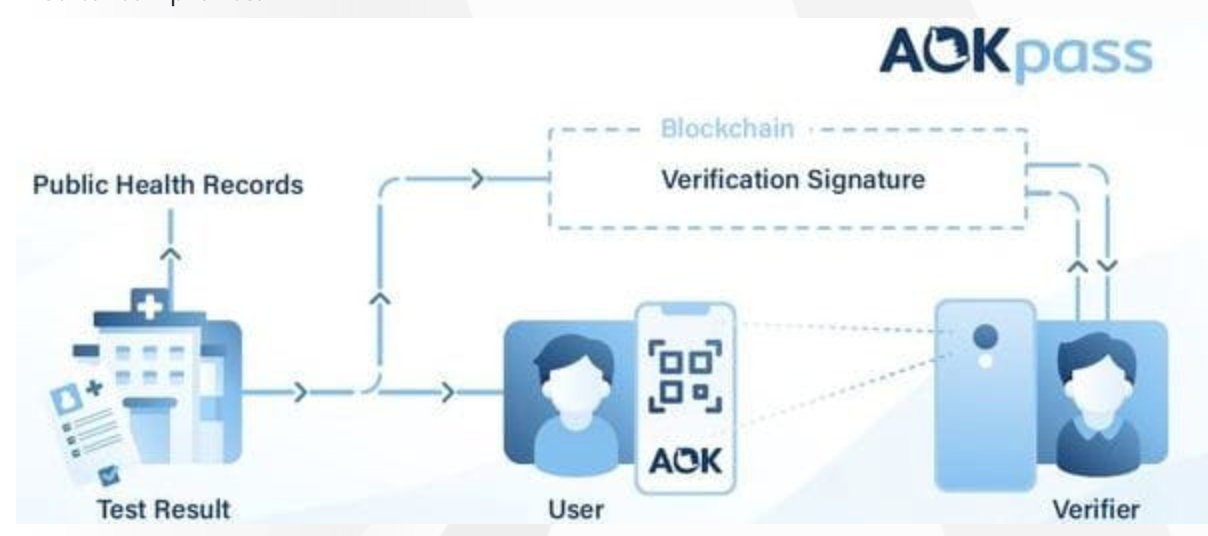
Source:SOS.com
Notably, another coalition involving Microsoft, Oracle and Salesforce is working on a digital COVID-19 vaccination passport that will encrypt data regarding an individual’s vaccination history, the proposal being that it will be downloadable onto a mobile phone. Those without a mobile phone can print off a QR code to prove they have been inoculated. As yet, it is unclear whether this cohort is using Blockchain technology but, in December 2020, Salesforce was reported to have been working with IBM in creating a digital passport that did use a Blockchain-powered platform. It is hoped that these digital proofs of vaccination will enable people to travel, attend international sports events and concerts etc with less concern. However, will we see people being banned/deported if they do not have their data available?
One wonders that if corporations such as those mentioned above are able to gain access to government records such as health records, then why not passport details or driving licences so doing away with more paper-based documents? One of the irritations when dealing with any official/regulated entity is the requirement to prove who you are since these firms are compelled by Know Your Customer (KYC) regulations. So, why can we not have a way to prove digitally who we are? Due to COVID-19, couriers such as FedEx and UPS have abolished the need for customers to physically sign for goods. However, a UK-based firm, Nugget, has developed a Blockchain-powered app which keeps one’s biometric identity so that as the courier nears the delivery address he can ‘ping’ the consumer from a mobile device to verify identity and hence receive the goods; therefore, no need to have your driving licence, utility bill, passport at hand to prove who you are.
So exists a variety of solutions that, by using Blockchain technology (which is able to offer solutions to remove many of the paper documents we have been reliant on for years), can improve the efficiency of travel, financial services and deliveries, to name just a few, and help citizens in the increasingly digital society in which they now found themselves.