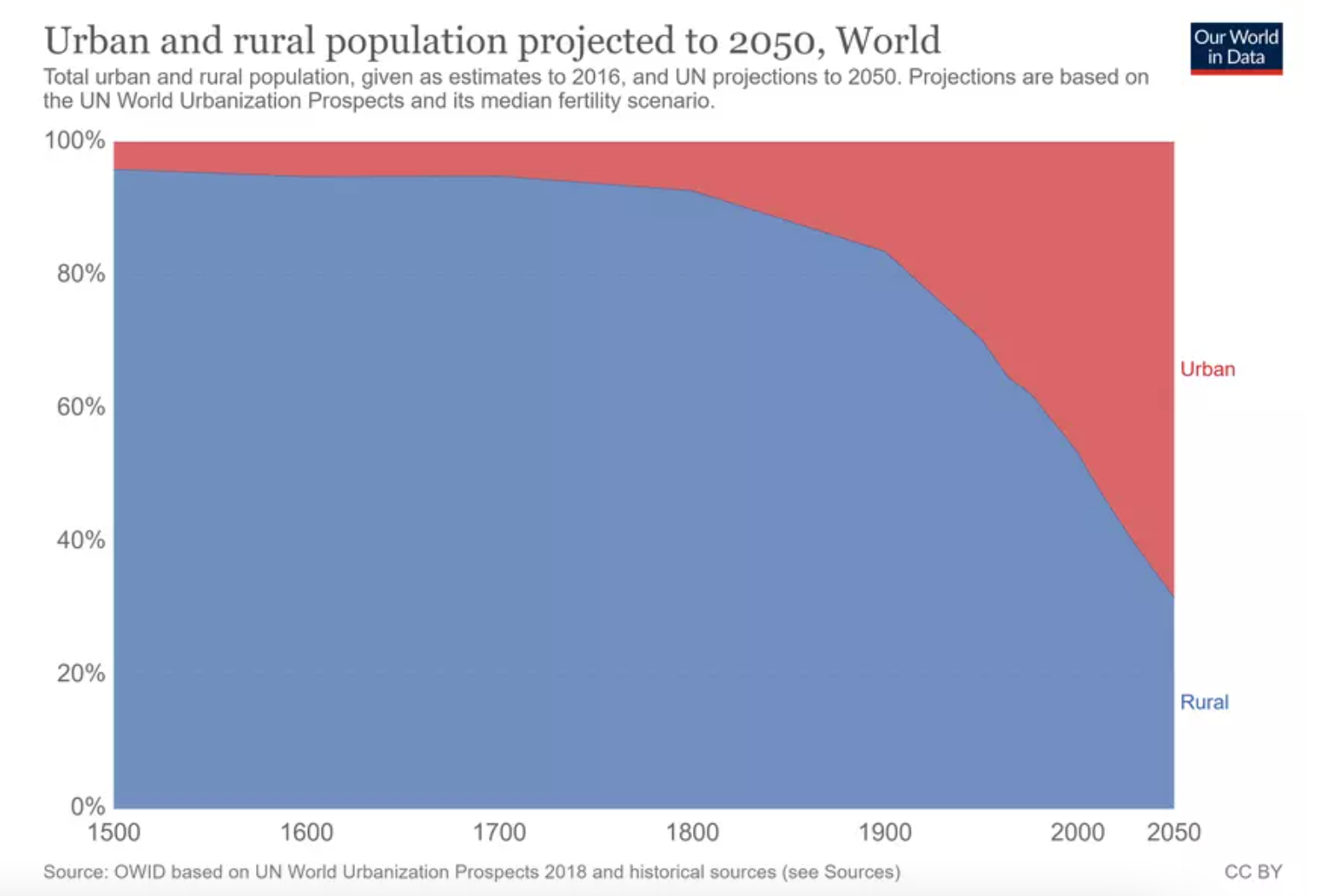
How the world has become urbanised
Source: World Economic Forum
In more simplistic terms, a smart city looks to improve transportation, reduce congestion, and create more inclusive social services all the while being sustainable, so making the city a more desirable place to live and, in essence, solving the challenges of urbanisation such as increased demand for energy, water, transportation, waste disposal by using technology. City planners are realising that to make cities fit for purpose and ‘smart’, data is the key. Technology, such as Internet of Things (IOT) connected by using Blockchain-powered platforms, offers some real advantages in terms of collecting, managing, holding, and sharing data in a distributed but secure manner. This is opposed to centralised systems (which often lack the ability to scale and are reliant on one organisation) having control of all the data and, even worse, if hacked or subject to cyber-attacks the database is reliant on only one point of failure.
For example, a Blockchain-powered platform can store the history of vehicle accidents, their maintenance, miles driven, when and by whom. From this, premiums could be adjusted (depending on particular vehicles and the drivers) since data on insurance claims and maintenance parts can be processed automatically based on IoT devices inside a vehicle. Furthermore, as regards transportation, research has been carried out looking at how to try and minimise Particulate Matter (PM) from tires and brake dust with the use of Blockchain technology being chosen because the researchers claimed this technology had the ability to:
All of these are important in developing human centric solutions to technical Smart City problems.
In the US, there are plans to create a smart city called Painted Rock in the state of Nevada, covering 68,000 acres. Unveiled last year, the plans envision a city of more than 36,000 residents, 15,000 homes and 11 million sq ft of commercial space. Blockchain LLC (the company behind these plans) estimates that eventually the city will generate $4.6bn in output annually and will be run using Blockchain technology. In Dubai, there are even greater ambitions with Digital Dubai stating: "Adopting Blockchain technology Dubai stands to unlock 5.5 billion dirham in savings annually in document processing alone — equal to the one Burj Khalifa’s worth of value every year. The Dubai Blockchain Strategy establishes a roadmap for the introduction of Blockchain technology for Dubai and the creation of an open platform to share the technology with cities across the globe. The Dubai Blockchain strategy is built on three pillars of government efficiency, industry creation and international leadership.” In order to fulfil its ambition to be a smart city using Blockchain technology, the Dubai Future Foundation has created the Global Blockchain Council. The Council will have 46 members including government representatives, global firms, UAE banks and international Blockchain technology firms.
In conclusion, IOTforall.com, summarises why it thinks the use of Blockchain technology will prove to be vital for the development of smart cities: “There exist many solutions that utilize blockchain technology for cities of the future. For example, smart contracts. These agreements can be executed autonomously if pre-established conditions between several parties (for example, a human and machine or a machine with other smart systems) are met. Blockchain technology does the job of storing smart contracts due to its security and technological immutability. The decentralized storage of data requires a distributed cloud storage system. Blockchain technology can be used to create a secure and encrypted cloud analogue, ensuring accountability and transparency”.


 Written by Jonny Fry
